
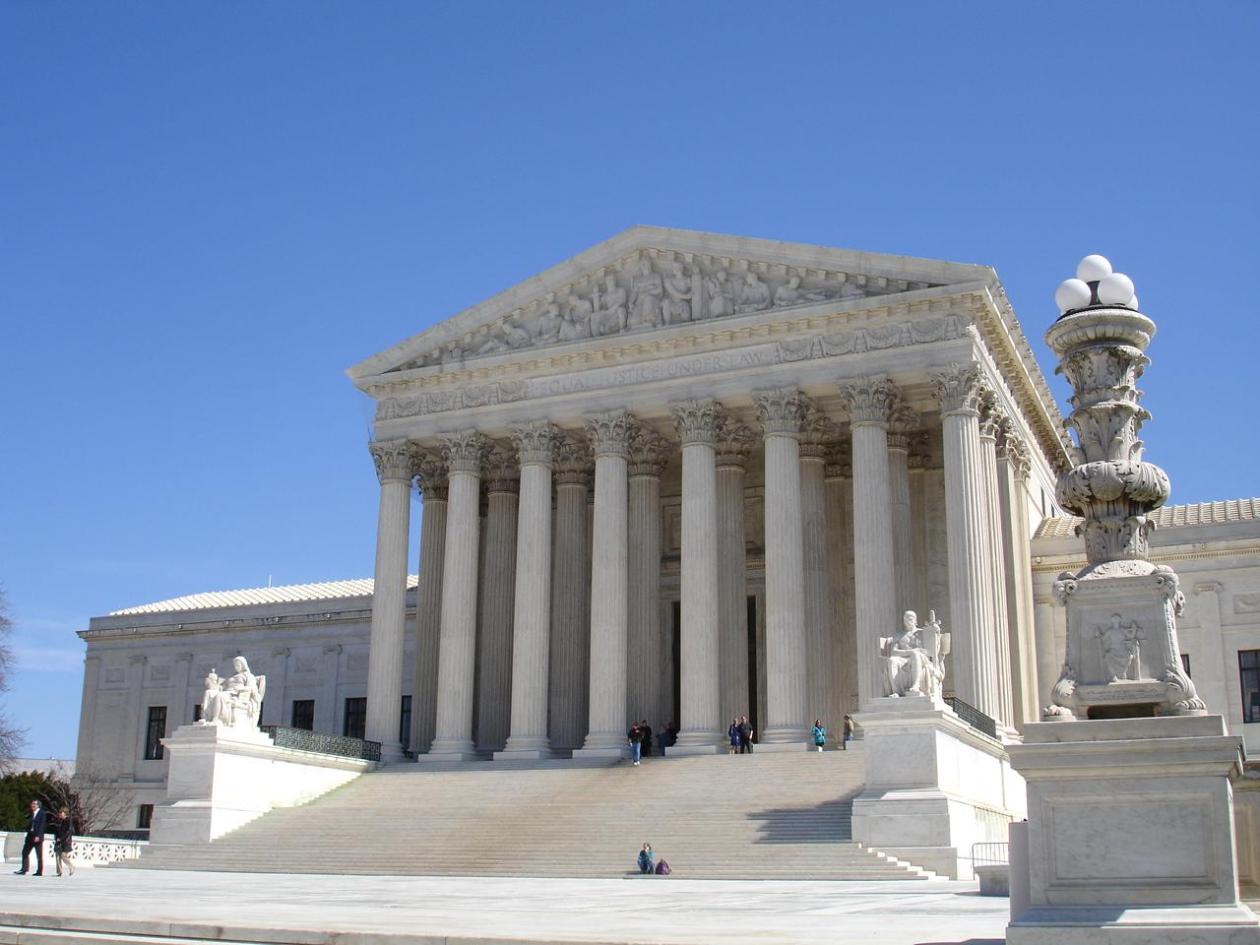
There is a growing consensus among federal appeals courts that law enforcement can request tracking data from a user’s cellphone without a warrant and without violating the Fourth Amendment’s protection against unreasonable search and seizure. The Supreme Court just decided this past Monday (6/5/17) in Carpenter v. USA to answer the question whether the Fourth Amendment permits this type of seizure.
Our phones contain an amazing amount of data about our personal lives. They contain our private emails, browsing history, passwords, and photos. But, they also track where we go with an amazing degree of accuracy.
Every time you use your phone to send a text message, to make a phone call, or to get a push notification, your phone logs location information with the nearest cell tower.
At a Monroe County Bench/bar conference at Shawnee a few years ago, an expert gave a presentation on how our District Attorney’s office is able to take a cellphone and use software to track the user’s past whereabouts. The detail in the information is rather surprising, or at least it was to me. The expert took someone’s cellphone and was able to create a “flyover” video showing the user’s location over time. You can imagine how useful this information might be to law enforcement in certain cases.
In Carpenter v. U.S., an assistant U.S. Attorney was investigating a series of armed robberies that occurred in southeastern Michigan and northwestern Ohio. Timothy Carpenter was a suspect in the investigation.
Instead of asking for warrants based on probable cause, the prosecutor asked for orders under the Stored Communications Act, 18 U.S.C. §2703(d). The statute authorizes such orders when the government “offers specific and articulable facts showing that there are reasonable grounds to believe that” the records sought “are relevant and material to an ongoing criminal investigation.”
In Carpenter’s case, those records showed each of Carpenter’s incoming and outgoing calls over the course of 127 days, along with the cell tower and directional sector of the tower that Carpenter’s phone connected to at the start and end of most of the calls. A separate order directed Sprint to produce cell site location information for Carpenter’s phone while it was roaming on Sprint’s cellular tower network. The data obtained showed Carpenter’s phone relative to the locations of the robberies.
Before trial, Carpenter’s attorney moved to supress the records on the ground that the Stored Communications Act was unconstitutional under the Fourth Amendment in allowing his records to be released without a warrant based on probable cause. The District court denied the motion on the grounds that the request for the phone records was not a Fourth Amendment search.
Carpenter was convicted of six robberies. On appeal, a divided three-judge panel of the Sixth Circuit held that no search occurred under the Fourth Amendment because Carpenter had no reasonable expectation of privacy in cell phone location records held by his service provider.
In asking the Supreme Court to hear the appeal, Carpenter noted that the Circuit Courts of Appeals are split on whether there is a reasonable expectation of privacy in historical cell site location information.
The Third Circuit, in which Pennsylvania is located, has ruled differently. The Third Circuit has held that magistrate judges have discretion to require a warrant of cell phone location information if they determine that the location information sought will implicate the suspect’s Fourth Amendment privacy rights by showing, for example, when a person is inside a constitutionally protected space.
SCOTUS has now agreed to resolve this Circuit split in an example of how our technology continues to erode our personal privacy.
